All the lacing holes on the stays are done! Weeee. Well, if you don't count the ones that the shoulder straps will sport- there are no shoulder straps yet. On to the boning, but first, the battante. Which is now completely cut out. Oh what a pain silk sateen is to cut! Slippery, slippery, slippery! I'm used to working with silk taffeta, which is a dream to cut.
And speaking of silk taffeta, I was drooling over B. R. Exports wonderful fabrics, and came across these:
http://www.puresilks.biz/store/index.php?act=viewProd&productId=335
http://www.puresilks.biz/store/index.php?act=viewProd&productId=1493
Don't you think those would make great battantes? I think taffeta would drape better in a battante than the sateen will, and I really love those striped ones in the paintings. I think that if I will like my battante, I will make another, striped one. There will be more 18th century weekends, and a battante would make a wonderful morning gown, even when I will be able to wear my stays again.
Showing posts with label regency stays. Show all posts
Showing posts with label regency stays. Show all posts
Monday, 26 April 2010


Friday, 19 February 2010
The history of stays
My history, that is. I’ve made several and I feel the need to make an overview. I hope you feel it entertaining. Perhaps even useful… My first pair was the Diderot stays pattern, which I found at La Couturière Parisienne. I started on those back in 2000, before I joined Gustafs Skål. I had made stays for theatrical performances before, using the bodice of a polonaise in Janet Arnold’s Patterns of Fashion. They were made without much guidance at all and wasn’t aimed to be historically accurate at all. No tabs, metal boning and not very boned at ll. So I wanted to make a pair that was historically accurate and hand-sew the thing. Green linen with blue linen-thread for the boning channels and blue silk for the lacing holes. They were very pretty. They were absolutely awful to wear. You see, I had no idea at all how to fit stays at the time and they were too long and too tubular. I had also boned them with MM, because that was all I could get my hand on then. Despite the flimsy boning the shape still gave me bruises over my ribs, that’s how poorly fitted they were. I considered re-boning them with something sturdier, but decided not too.
Having put all this work into something that I had to discard, made me very reluctant to put much work into my next pair. Indeed, this is what I’ve done since; made a pair that have been wearable but quick and ugly that I have used for a long period, before trying to do something pretty. For my next pair I tried a new pattern, the front- and back laced stays with a stomacher from Norah Waugh’s Corsets and Crinolines I made them out of two layers very sturdy twill. I boned them with plastic whalebones.

They were much better, but I needed to tweak them, shortening the waist and making the stomacher wider and a bit longer. I decided to make them in very nice red linen with white boning stitches. I used white linen tape to bind them, and a lot of fussy work that was! And as you can see, it was pretty impossible to make it lay flat. They were boned with plastic whalebones, but in the back I corded every other channel, which still made them sturdy, but breathable.


I really liked them, they were comfortable and pretty, but there were still fitting problems. Still a bit too long in the waist and too wide in the back. I also found it fussy to put on with the stomacher and a bit hard to get it to look right. So I started to experiment with other patterns. I tried out the Corset Pattern Generator and got a functional pattern.

However, these are 16th century stays and the shape then was not as conical as the 18th century. Being quite conical to begin with, I found that the straight shape didn’t suit me.
The next patterns was a variation of the shape that seems to have been very common. Very much like this, only number one and two are one piece. I made them quickly out of black denim.

And just to see how it would look to cover it with a fabric that don’t have boning channels, I covered them in golden silk taffeta.

They were still better than the pair before, but I made them and then lost a lot of weight and they were suddenly they were much too big, bringing me to the pair I currently wear.


They were made out of one layer of black denim and one of upholstery velvet. I made them without shoulder straps, just to see how that worked out and I made them laced both in the front and the black. I was a bit lazy and re-drafted it with just two pattern pieces instead of four. They turned out very well that I have been trying them out for two years, but now they are too big as well, so the time had really come to make a new pair.
Though not having should straps have worked well, I definitely feel that I want them. My breasts have shown a tendency to “float away” towards the sides, so I want the straps to keep them were they are supposed to be. I also felt that I needed to lengthen them a bit in the front and place the tabs in the fronts a bit different. I also needed to make the pattern a bit smaller. As I still shrink, they will still be laced both in the front and in the back. As I like to make clothes that could have been worn in Sweden I looked at extant Swedish stays. They seem to look just the same as stays do elsewhere. They can be laced in front or in the back or both, with or without a stomacher. I also looked in Jill Salen’s Corsets for inspiration and found the brown jean stays, dated around 1780.. The patterns looked quite like my pattern and I liked the look of the boning channels and the square tabs, so I decided to re-draft my pattern with that on in mind.

A thing that I liked with the brown jean stays are that the front piece is cut on the bias. I’ve never done that before and I’m curious to see how that will affect the fit and shape. And as my shape is a bit different, the number of tabs and the exact placement of boning channels didn’t work out for me. Another thing I liked was that the centre front piece is slightly curved at the side towards the side front piece. So, now everything is set (and started) for the next pair.
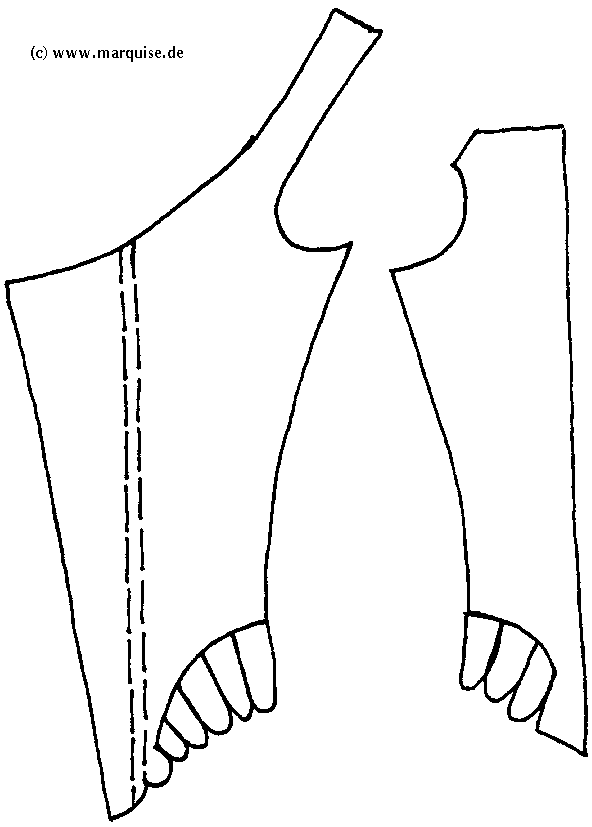
Having put all this work into something that I had to discard, made me very reluctant to put much work into my next pair. Indeed, this is what I’ve done since; made a pair that have been wearable but quick and ugly that I have used for a long period, before trying to do something pretty. For my next pair I tried a new pattern, the front- and back laced stays with a stomacher from Norah Waugh’s Corsets and Crinolines I made them out of two layers very sturdy twill. I boned them with plastic whalebones.

They were much better, but I needed to tweak them, shortening the waist and making the stomacher wider and a bit longer. I decided to make them in very nice red linen with white boning stitches. I used white linen tape to bind them, and a lot of fussy work that was! And as you can see, it was pretty impossible to make it lay flat. They were boned with plastic whalebones, but in the back I corded every other channel, which still made them sturdy, but breathable.


I really liked them, they were comfortable and pretty, but there were still fitting problems. Still a bit too long in the waist and too wide in the back. I also found it fussy to put on with the stomacher and a bit hard to get it to look right. So I started to experiment with other patterns. I tried out the Corset Pattern Generator and got a functional pattern.

However, these are 16th century stays and the shape then was not as conical as the 18th century. Being quite conical to begin with, I found that the straight shape didn’t suit me.
The next patterns was a variation of the shape that seems to have been very common. Very much like this, only number one and two are one piece. I made them quickly out of black denim.


And just to see how it would look to cover it with a fabric that don’t have boning channels, I covered them in golden silk taffeta.

They were still better than the pair before, but I made them and then lost a lot of weight and they were suddenly they were much too big, bringing me to the pair I currently wear.


They were made out of one layer of black denim and one of upholstery velvet. I made them without shoulder straps, just to see how that worked out and I made them laced both in the front and the black. I was a bit lazy and re-drafted it with just two pattern pieces instead of four. They turned out very well that I have been trying them out for two years, but now they are too big as well, so the time had really come to make a new pair.
Though not having should straps have worked well, I definitely feel that I want them. My breasts have shown a tendency to “float away” towards the sides, so I want the straps to keep them were they are supposed to be. I also felt that I needed to lengthen them a bit in the front and place the tabs in the fronts a bit different. I also needed to make the pattern a bit smaller. As I still shrink, they will still be laced both in the front and in the back. As I like to make clothes that could have been worn in Sweden I looked at extant Swedish stays. They seem to look just the same as stays do elsewhere. They can be laced in front or in the back or both, with or without a stomacher. I also looked in Jill Salen’s Corsets for inspiration and found the brown jean stays, dated around 1780.. The patterns looked quite like my pattern and I liked the look of the boning channels and the square tabs, so I decided to re-draft my pattern with that on in mind.

A thing that I liked with the brown jean stays are that the front piece is cut on the bias. I’ve never done that before and I’m curious to see how that will affect the fit and shape. And as my shape is a bit different, the number of tabs and the exact placement of boning channels didn’t work out for me. Another thing I liked was that the centre front piece is slightly curved at the side towards the side front piece. So, now everything is set (and started) for the next pair.
Friday, 28 August 2009
This and that
I’ve been given an award by Madame Berg. Thank you! Evidently I have to nominee people now, but I’ll have to think about that.

I’m making some changes in my sewing schedule. The Vauxhall will be in three weeks and I will finish my gown before the Regency stays. Why? Because my gown was made in 1797, and it’s quite likely that it was made for 18th century stays. I wanted Regency ones because of 1809, but the timeframe for the Vauxhall is 1772-1809. If I have the time I will finish the later stays, if not, I still have a gown. In Kvinnligt mode the cut of the 1790s round gown and one of the Regency gowns are very similar, apart from the length of the bodice. I’ll cut the 1797’s gown somewhere in between and then I think it can be worn with both kinds of stays. Truth is that with my well-endowed high-waisted body, the waist of a Regency gown would probably be lower than for someone slim and small-chested, anyway.
I’m happily reading my book about Gustaf III’s national costume, and I’ve decided to sew the common gown. Partly because everyone who has it in Gustafs Skål has the court version.

Also because that even if we don’t have personas in Gustafs Skål, I’m aiming to make clothes a woman of my family could have worn. And this means very well to do, upper-class that married into nobility, but lived in the province of Värmland, far from the capital. Which means the common gown with black sleeves instead of black-and-white, shorter train, and with the train up at four points.
The only preserved national gown is just a common one.

Tuesday, 25 August 2009
Book and stays
I’ve long wanted a book about Gustaf III’s national costume, Studier rörande Gustav III:s nationella dräkt by Eva Bergman, that was published in the thirties. Last week I found it online for basically nothing- it’s not hardcover, but in very good shape. I got it yesterday. Yay! Now I have no excuse whatsoever for not making it. I have the fabric, I have the pattern and now I even have the book. I’m aiming to have it done to the 12 night ball Gustafs Skål will have in January
I tried my Regency stays the other day and the good thing is that it fits very well over my waist and hips. It’s the first time I’ve tried boning with reeds, and they seem to work very well. I put boning channels beside the busk and on both sides of the front side-seam. And on both sides of the lacing holes. I thought I would need more boning, but it seems not. However, the cups are another matter. I definitely need to cut the front higher and also widen the gussets a bit. They work, kind of, now and I will follow advice of adding a strip of fabric to make it a bit higher, as I don’t have that much time before I need to use it.. And I will remove the wide busk and put in a much narrower. The wide one may be period, but my breasts aren’t small and it doesn’t work to have them pushed apart sp far. So a new busk channel, an additional stripe of fabric for the front and then finish the edges and I’m done.
I tried my Regency stays the other day and the good thing is that it fits very well over my waist and hips. It’s the first time I’ve tried boning with reeds, and they seem to work very well. I put boning channels beside the busk and on both sides of the front side-seam. And on both sides of the lacing holes. I thought I would need more boning, but it seems not. However, the cups are another matter. I definitely need to cut the front higher and also widen the gussets a bit. They work, kind of, now and I will follow
Sunday, 23 August 2009
Aaargh!
While sewing boning channels in my regency stays I did a stupid mistake that I really know better than to do. I put a big unsightly scorch mark at the front of the stays. While I hadn't planned to prance around just in my stays, it really bothers me.
Thursday, 20 August 2009
More than the 18th century
Two years ago, I sew a 40's evening gown:

It was a lot of fun to sew and I felt I wanted to do a short version, when I found the right fabric. And at a visit to Carina's fabric shop, I found the fabric. Rather surprising actually, as it has flowers on it. And I'm so not a flowery fabric person. But it spoke to me, and I bought it, and when I dug out the pattern, I understood why.

My sub-conscious mind has obviously a much better memory than my conscious. It's rayon, though, and pure hell to cut and sew in, so I'm still working on assembling the pieces.
Other news is that I'm sewing the boning-channels on my Regency stays. I'm nervous of the fit- it's the first time I've sewn something with bust gussets. And I think it may be cut too low...
Subscribe to:
Posts (Atom)
