Showing posts with label caps. Show all posts

Monday, 28 September 2015

Fontange caps

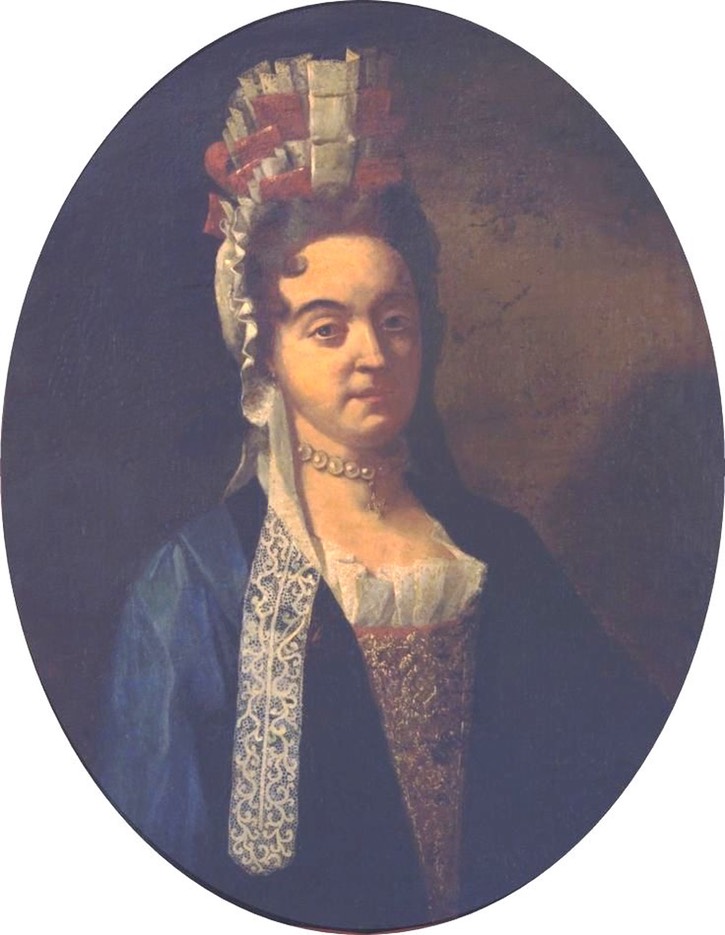
High on my wish list is a 1690-1710 mantilla and with that I would need a fontange cap. This rather absurd cap fashion became popular during the 1680’s and remained popular until the 1710’s, or so. It was usually paired with a high hairstyle, confusingly enough usually called a fontange hairstyle. To be technical the fontange was the ribbons on the cap, the high pleated frill was called a frelange. As it rose higher and higher it was supported by a wire construction called commode.

The only extant fontange cap, as far as i know, is actually worn by a doll, known as Lady Clapham. V&A describes it like this:

Circular doll's cap consisting of the cap, wire and ribbon. The cap is made of spotted lawn edged in English bobbin lace which falls into two lappets on either side of the face. It has a graduated double frill ('Monte la haut'), a narrower frill in front and a taller frill behind. The frill is supported by a wire covered in muslin formed in a semi-circle with eight radiating spokes graduating to the highest in the centre. The cap is circled with pink silk taffeta ribbon which is twisted about the cap, and is tied in two bows and lined with brown silk. The ribbon is padded in between and sewn to a cotton band which forms a base to attach to the doll's head. The cap is secured by a linen cord drawn through the back breadth.

 
Victoria & Albert
Unfortunately no one seems to have made a proper pattern.
 
 
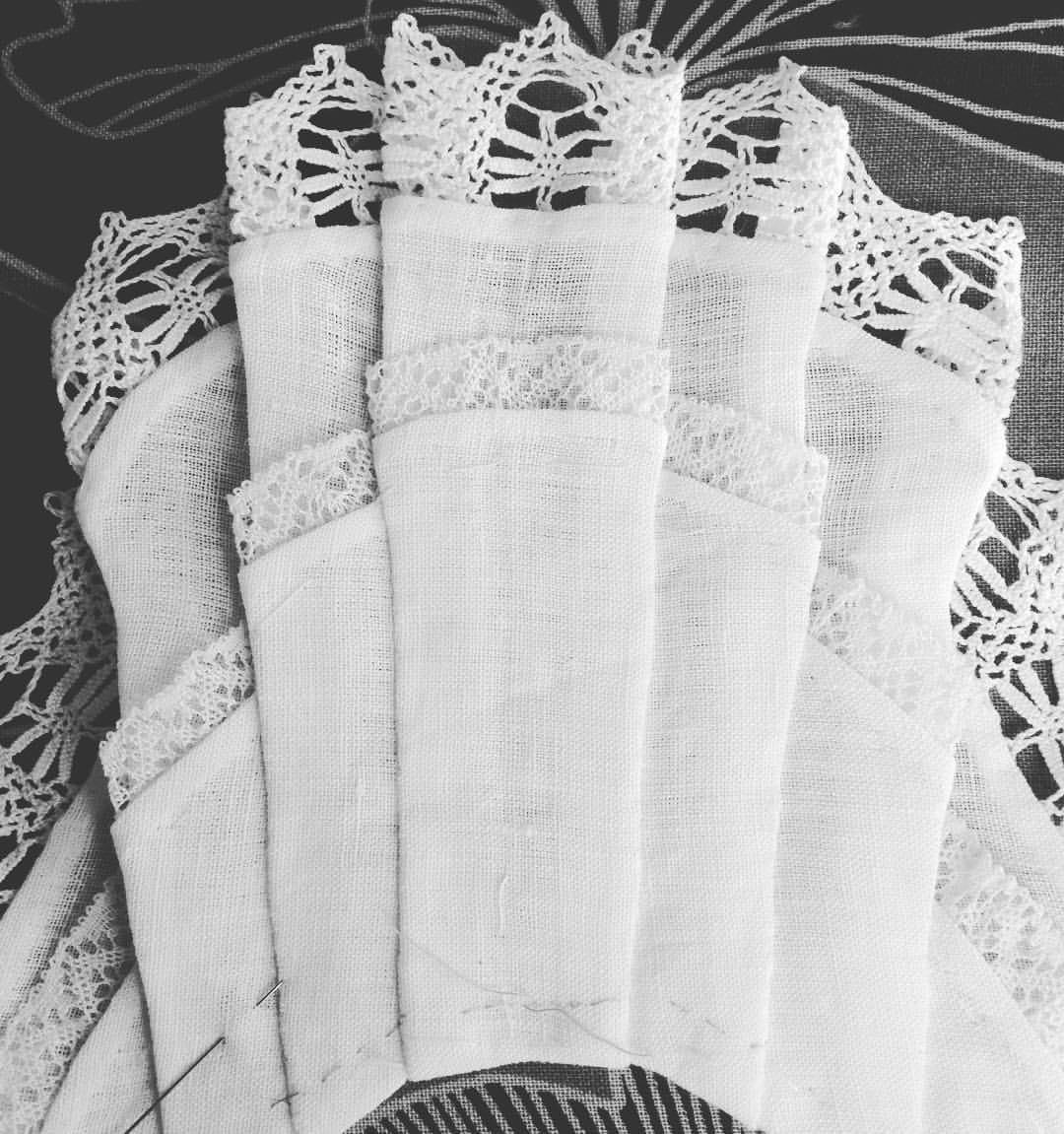
If you look at art, the standing frill seems to have been done rather differently. 
 
Anne de Souvré, marquise de Louvois by Simon Dequoy, 1695

16Mme Roig, née Theresa Gazanyola, unknown artist, 1699

María Luisa Gabriela de Saboya by Miguel Jacinto Meléndez, 1712-1714


Unknown widow, ca 1690

Maria Anna of Pfalz-Neuburg by Godfried Schalcken, 1690 
Go to the web page to be able to zoom in.
 

Marchioness Angela Maria Lombardi, unknown artist, ca 1710

Recueil des modes de la cour de France, 'Femme de qualité, en d'Eshabillé d'Esté' by Nicholas Arnout, 1687
I’m making a modified version of two layers of fine white linen and lace made by my grandmother.

Monday, 7 April 2014

The (un)wired cap

My cap is done and though it turned out OK, it did not turn out the way I wanted it. It doesn't matter much, though, because I need several caps and the way this one turned out, it works very well for some of my clothes. I was aiming to make a small wired cap, suitable for the period 1740-60, the research can be found here and here but as you can see it isn't that small and more suitable for a lter period where a wired brim doesn't seem to have been popular anymore. So I decided to just starch the brim and leave it as that. My original plan was to make the wired cap with a lace brim, but decided on linen because I found that I had no leftover lace at home, so I'm not sad, now I can make it the way I wanted it to begin with. As I starched the brim, it did stand up a little on its own anyway.


I based my pattern on the shape of this cap on Duran Textiles, but made it smaller. Not small enough as it turned out, though. The band was cut out from what remained of my fabric, it got to be about 80 cm long, and when hemmed, 6 cm wide. Both cap and brim were then hemmed as narrowly as I could, which turned out to be about 3 mm. When I made my 17th century shirt I got the tip to lightly starch the fabric before hemming it and that made the process much easier.
The edge of the crown was gathered down to 36 cm and the brim pleated to the same measurement. Then I arranged it on my ironing board, roughly mimicking the shapr of the crown, you can see the pins holding it down.

Then I ironed it so all the pleats got flat, removing the pins as I went. After that I starched the brim as heavily as I could.

The last moments were to whipstitch crown and brim together and pleat the back. I wore it for the first time last Saturday when I held a lecture on 18th century makeup at Kristinehovs malmgård, an 18th century manor house in Stockholm. I paired it with b´my blue and white striped 1790's gown. The lecture was held in the Animal room, which holds an owl on the clock, a parrot on the lamp, mice on the floor and butterflies and birds on the walls. Here I am pointing at the bird's nest.


Close up on the bird's nest. The wall paper is a copy of an 18th century one found in the theatre at Drottningholm's castle.


The Challenge: #7 Tops and toes
Fabric: Lightweight linen
Pattern: Self-drafted but heavily influenced by one of the patterns found at Duran Textiles.
Year: Last half of the 18th century.
Notions: White sewing thread in silk, starch.
How historically accurate is it? Pretty accurate. The pattern isn't original, but it is hand-sewn and constructed in a similar manner to extant caps.
Hours to complete: 14
First worn: April 5 when I held a lecture on 18th century makeup.
Total cost: Don't know as I used linen scraps.


Friday, 4 April 2014

Extant 18th century caps

The actual sewing on my cap is done, now I have to sew in the wire and see if my idea on how to do actually work when it is applied. Very exiting... You can see a previous post on the subject here. I have also found an article on just earlier 18th century caps at A Most Beguiling Accomplishment. Here is also a few extant caps. None of them are wired, but wire must have been easy to remove so you could wash the cap and perhaps it was also removed to change the look of the cap.

Three lace caps. The first is just dated to the 18th century, but I think it is quite correct to assume that it should be dated to around 1750.

Flemish cap, 18th century

French cap ca. 1750
 
Belgian cap ca. 1740
Cap, probably American, 1750-1799


Cap, 1751-1800


Cap, 1750-1800

Cap, 1775-1800
Cap, 1775-1799


Mourning cap in pleated silk and black crape
Cap, 1785–98


Saturday, 29 March 2014

18th century wired caps

Detail from a portrait of an unknown lady by Ulrika Fredrica Pasch, 1770
All my sewing projects have been on hold for the past couple of weeks as I have had another bout of bronchitis coupled with a tummy bug. I really, really don't recommend that! I'm basically well now, but still weak and tired and it says something that I haven't even done the tiniest amount of sewing whatsoever. And as I still don't feel up to do anything big, I have decided to make an 18th century cap. Small, needed and quite fast. Perfect.

Actually, I need more than one, a small one that goes for the earlier 18th century and a big one for the later decades. However, I will make a small one now. I have had my eyes on a style that seems to have been popular 1740-1770, or so, where the ruffle is standing out like a halo around the face and is often called wired caps. After looking at ever cap of that kind I realized that even if they have the halo effect, there are several styles to this kind of cap. It is never easy, is it? I strongly suspect that caps were never ever a set style, but rather something you made up as you went, borrowing style elements from where it pleased you. Of course, geography and current fashion trend are influences that lay heavy on you.

A basic cap has a rather simple construction, there is the crown and the band at the very minimum and very often a ruffle. Some also have lace lappets that hang down the back. Extant examples show that the whole cap could be made of linen or lace, or a combination of materials. As crown, band and ruffle could have a variety of shapes, which must have been a very easy way to obtain different looks. For some useful information and free patterns, see links at the end of the post.

I'm uncertain if all caps that stand out from the face are wired. Some may very well be just heavily starched. The first picture at the post and the ones just below here, are clearly wired. At first I thought that the lace was pleated, but thought that may be the case on some, I also think that it is mounted on a wire framework. It looks like pleating at the first glance, but the lace pattern would be broken if there were pleats.
 

This cap looks like it is pleated, on the other hand. You can also see what looks like wire running through the middle and top.


Detail from a painting of an unknown woman by Benjamin Branting Nilsson
Detail from a portrait of Countess Maria Eustachia Porporato by Maria Giovanna Clementi La Clementina
Detail from a portrait of Annushka, a serf from Siberia by Ivan Argunov, 1767
In the company of a lot of fake pearls.


Many caps have this little dip in front, which is probably a lot easier to maintain if the edge is wired than just starched and shaped.

Detail from a portrait of a noblewoman by Donat Nonotte, 1760
Detail from a portrait of Madame François Buron by Jacques Louis David, 1769
This one doesn't look so stiff, so perhaps it is just heavily starched, but I also thik that it may be a wire encased inside the white ribbon.


Detail from a portrait of Dorothea Sopia Thiele by Anton Raphael Mengs, 1744
Detail from a portrait by Pietro Rotari

A few black lace caps. I assume that this is a widows mark as the women wearing black caps seems to be middle aged.


Detail from a portrait of Empress Maria Theresia of Austria by Jean-Étienne Liotard
Detail from a portrait of Madame Sophie by Franz Bernhard Frey, 1766
Detail of a portrait of an unknown lady by Louis Tocque

Caps that I think are just starched and not wired. Perhaps.
Detail from a portrait of Portrait of Madame Restout by Maurice Quentin de La Tour, 1738
Detail from a portrait of the child Nicole Ricard by Maurice Quentin de La Tour
Detail of a portrait of Kristina Sofia Sack by Gustaf Lundberg

Caps that are tied under the chin.
Detail from a portrait of Theresa Concordia Mengs by Anton Raphael Mengs, 1745
Detail from a portrait of Rosamund Sargent by Allan Ramsey, 1749
Detail from a portrait of Madame Lenoir by Joseph Siffred Duplessis, 1764
Detail from a portrait of Mademoiselle Salle by Maurice Quentin de La Tour

Detail from a portrait of Countess de Rieux by Maurice Quentin de La Tour, 1742
Generally these caps seems to be made of lace and not plain linen. The front are sometimes cut into two separate halves, sometimes in one piece. The nes tied under the chin looks softer and may not be wired at all and they are more often pleated. I haven't decided if I'm going for a cap with a lace front or one on plain linen, but I will make it pleated and just reinforce it. Duran Textiles has several free cap patterns, so I will use one of them as a template.


Several links to extant caps collected by The 18th Century Notebook can be found here.


Commercial cap patterns:

Wired cap pattern

Cap patterns from Nehelenia Patterns

I haven't found anyone who has made a wired cap, but here are a few other cap tutorials of interest:

A Frolic Through Time has made an adorable dormeuse cap, part 1 and part 2 and part 3.

A Fashionable Frolic's round eared cap.

Couture Maya has made several caps.

Art, Beauty and A Well-ordered Chaos has a step by step tutorial for making a cap.


Related Posts Plugin for WordPress, Blogger...