Showing posts with label men's clothes. Show all posts

Wednesday, 10 July 2013

Making a 17th century shirt- setting in the sleeves and the gussets

The shirt is nearing its completion, the only thing left are the cuffs. The sleeves are very wide with only a portion of that gathered at the top of the shoulder. As with the collar, the body of the shirt is top-stitched to the sleeves.
 
 
The seam allowance are folded and sewn down invisibly, creating a false French seam. On the original shirt this is done on the side and sleeves seams.
 
 
Where the gathers are there is a strip of linen tape sewn over them. Probably because it would be too bulky to fold in the seam allowance. The inside looks very neat.
 
 
The gusset is a small rectangle, 8X8 cm when hemmed.
 
 
As my fabric doesn’t have selvedges, the fake French seams the original has would be much too bulky. Instead I sewed in the gusset from the right side. I always start with sewing the gusset from the corner were sleeves and bodice meet, first down the sleeves side, and then from the corner down the bodice side. After that I fold it so it meets the other side where the sleeve and bodice meet and repeat. Only I continue down the sleeve seam down the whole way, apart for a 10 cm long slit. Then I do the side seam the same way. As my shirt is shorter than the original one, my side split are much shorter, but start at the same place as the original, 46 cm down.
 
 
The gusset in place.
 
 
The side split is reinforced on the wrong side with a small rectangle of linen, 3X2 cm when hemmed.
 
 
The next post with show not only the cuff, but also the finished shirt.

Tuesday, 18 June 2013

Making a 17th century shirt- The neckband


10 meters of linen hemmed! It took me about 15 hours and they did get neater as I went by. I got the tip from Virginiadear at LJ that you can starch the linen for even more neatness and then wash it out, but as I had already started I kept going. I will keep it in my mind for the next time, though! I whipstitched the top and bottom of the sleeves as they aren't hemmed. Arnold doesn't say anything about that, but for my own sanity I wanted to keep any fraying at bay.
 
Next I cut the neck opening. Many of the shirts in Patterns of Fashion 4 has just a slit, but this shirt has an oblong shape cut out, with a slit 16 cm down the front. I kept the original proportions and whipstitched the raw edges. I also hemmed the slit with the same tiny hem as the rest of the shirt.
 

Next I cut two trapetzoid shapes that are re-inforcing the shoulder area. I kept the original proportions here as well, adding 0.5 cm on each side for the hemming. The ends are hidden when the neckband and sleeves are in place, so they are left unhemmed.


It is sewn to the wrong side of the garment, but the stitches can be seen from the right side. I am, by the way, using white cotton thread, not linen as in the original.

 
The neckband is s simple rectangle, folded lengthwise so it ends up being about 4 cm high. I added 0.5 cm all around for hemming. The neckline is gathered, but not all around. The "corners" of the oblong shape are left as they are, the front and the back are then gathered and the neckband sewn on. It is top-stitched from the right, which keeps the gathers in place, but also serves as a decorative element. I derived once again from the original linen thread and used buttonhole silk instead.
 
I think it looks quite neat if I may say so myself!
 
The end of the neckband has the sewing allowance folded against each other and then whip-stitched together. On the wrong side the neckband is hemmed so the raw edge of the neckline is completely covered. I also embroidered a "J" at the wrong side of the neckband, center back. The original has a "C" for Claes there, so I thought it fitting to add J's initial.


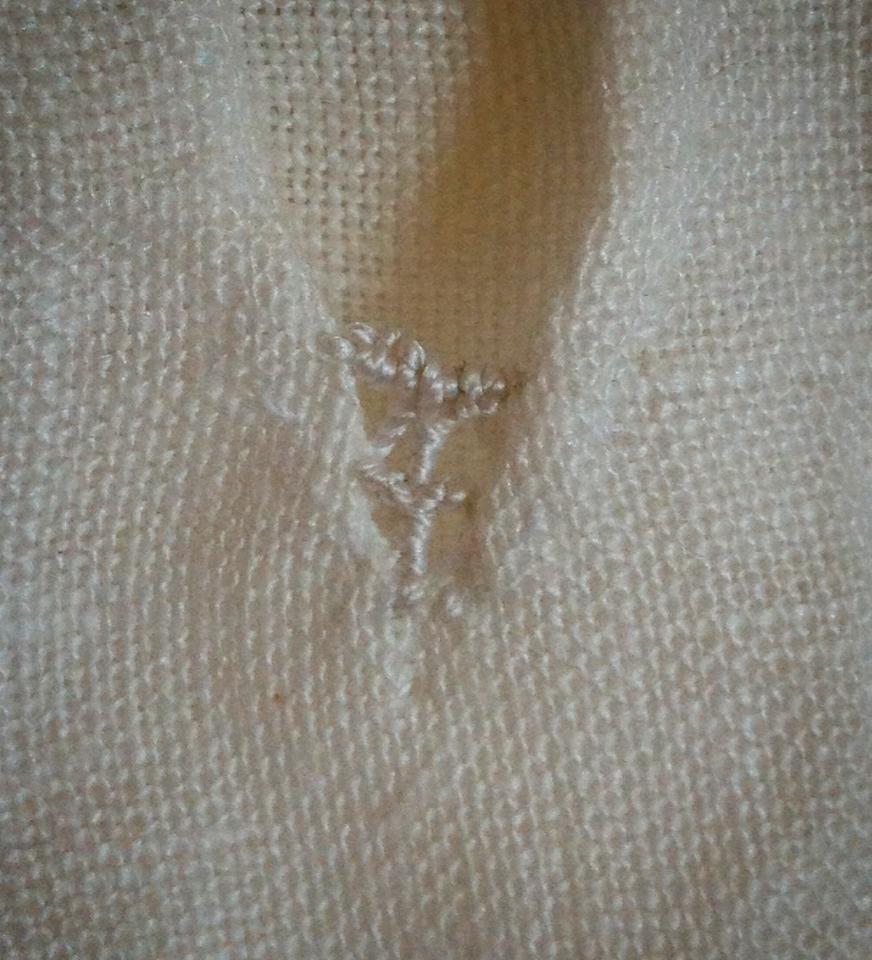
I then added the little spiderweb design at the end of the slit. Onca again this has a practical purpose and not just decoration. The end of a slit is a very fragile place and Arnold notes that several other garments have tears in just that place. The cute little spiderweb re-inforced that fragile area. I used buttonhole silk, first just outlining the design with a few threads and then covring those with buttonhole stitches.


The end result is nowhere as neat as the original, but it serves its purpose, I suppose.


Now: Onward to the sleeves!


Monday, 22 October 2012

Men in masks

Comparing to my past masquerade posts, this post have few pictures. Partly, I think, because I don't look at pictures of 18th century men as much as I look at those with women. But also, I am sure, because the fashion of getting a painting of yourself in masquerade costumes, never seem to have been very popular. Why I don't know. Perhaps it was felt to be too frivolous. Here is what little I have found:  


Portrait of Count Grigory Chernyshev with a Mask in His Hand by Louise Élisabeth Vigée Le Brun, 1793


Usually men in masks are part of a group containing both men and women.

Print made by Charles Joseph Flipart after Pietro Longhi, 1737-1750

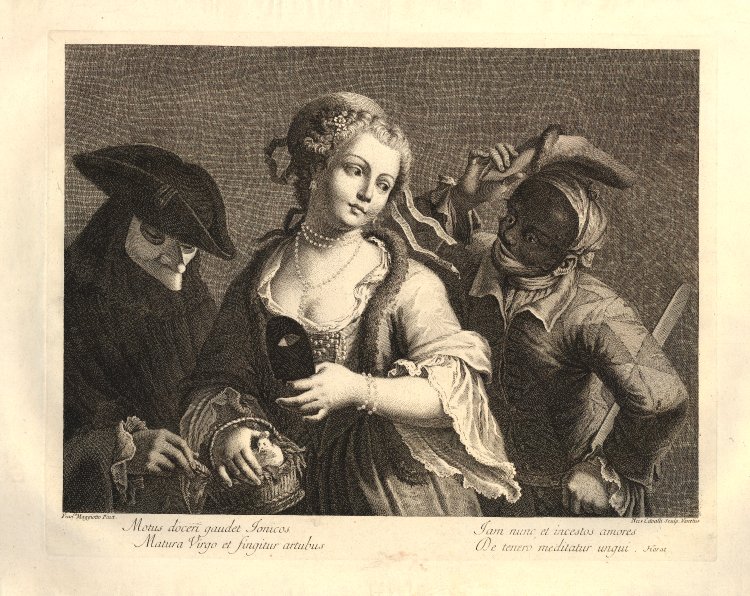
Print by Nicola Cavalli after Francesco Maggiotto

Or in more satirical artwork:


Wantonness Mask'd, 1771

The treacherous patriot unmask'd, ca. 1742


Thursday, 27 September 2012

What a man wore under his breeches


Couple with an Escaped Bird by Louis-Léopold Boilly, late 18th century 
 Now and then people ask about men's underwear in the 18th century. For a very long time I thought that they just had shirts. Though it seemed rather uncomfortable to not wear anything under the breeches, a long shirt would probably serve as a protective layer between skin and clothes. There are, however, a number of paintings and engravings of men with their clothes in disarray where you can clearly see that under the breeches you can see white knee-length underwear. Here on a painting by Boilly, where the straps are undone and the stockings folded. Quite shocking.

Linen underpants, 18th century, No. 22995, Armémuseum
Lucky us, we have more than just paintings. At Armémuseum in Stockholm a pair of "lårfoder" (thigh lining) have been preserved. They were a part of the standard uniform in Sweden in the 17th century and where made in coarse linen. I have seen them up close, and they didn't seem to have been very comfortable. But with unifrom breeches in heavvy wool, I guess linen underwear, even if coarse, was to be preferred.

Livrustkammaren in Stockholm has no less than two pairs of men's underwear in the same style as the one at Armémuseum. These, however, are made of fine linen and have belonged to King Karl XIV Johan before he became king of Sweden and was Jean-Baptiste Bernadotte, one of Napoleon's generals. They are dated to 1763-1818 and are probably French. They are quite similar to each other, so I just add the description of pair 21667:

Whiten linen underpants, 1763-1818, No. 21167, Livrustkammaren
Knee-length pants of white linen. Low-cut at the waist front and higher back. The waistband is wide in the front and tapers down toward the back, 70-60 mm wide. They are made with an inner and outside seam and a crotch seam. All seams are covered by a narrow white linen tape, 3 mm wide over the crotch seam and inner seams and 18-10 mm wide on the outer seams. The front has a large V-shaped slit, 147 mm long that fastens at the top with two white fabric-covered buttons. The button holes are 20 mm wide. Slit finished with a 4 mm wide band. The legs are finished with a 15 mm wide. The outside of the legs has 147 mm high slits which are tied together with white linen tape, 15 mm wide and between 430-490 mm ​​long. The back of a v-shaped slit, 130 mm long. The width of the waist is regulated by a 70 mm wide band entered through four eyelets, two on each side. The strips are crossed on the inside. The top edge of the waistband at the back is marked "IB" in red cross stitch. (Jean Baptise) On the inside of the waistband there is a "B" with white stitches.


Whiten linen underpants, 1763-1818, No. 21166, Livrustkammaren

So, evidently time to make gentlemen linen pants to wear underneath. As for ladies, even though there are no extant example, the Danish princess Sophia Magdalena had some 40 pairs of black knitted silk knickers in her trosseau when she came to Sweden to marry Gustaf III in 1766. Not for modesty's sake, but to fight the chill of the cold Royal castle.

L'epouse indiscrète, early 1780's

Related Posts Plugin for WordPress, Blogger...