Showing posts with label masquerade. Show all posts

Saturday, 16 March 2013

Unveiling a secret project- A wild man masquerade costume, anno 1778

Livrustkammaren in Stockholm have several masquerade costumes from 18th century. Some of them have belonged to the future Karl XIII, among them this one, "a wild man's dress" dated to 1778. I have always wanted to make it and this past month, or so,  it has been my very secret project. So secret that I haven't even told you that I was working on one. I was a bit afraid that it would turn out looking awful. But here is how J looked last night at a masked ball Gustafs Skål held and I think he looked great!

The original is in three parts, a close fitting jacket in white silk, a printed "leopard skin" kilt in silk and a "bear skin" in cotton flannel with claws made of tin. It is also decorated with leaves in silk. The lack of pattern, good pictures and written information made it impossible to truly copy the suit, so I opted for closely inspired. Instead of silk I made the jacket and leopard skin in the same cotton flannel as I used for the bear skin, I bought several yards of white  flannel and then died it brown and sandy brown yellow to suit.


Making claws out of tin was not an option, so instead I sculpted them out of paper clay, painting them silver. They each have a wire skeleton, ending with a little loop, making them easy to sew on. Having no real idea how the skin was shaped I drafted a, in my opinion, likely shape, directly on the fabric.

The original has a seam down the middle, but my fabric was wide enough for the whole skin. I then lined it with common red polyester lining- very unhistorical, but there was a time restraint so I couldn't hunt up a suitable silk lining. And last I attached all the claws. Even if paper clay is pretty lightweight, the combined claws gave the skin some weight. It was pinned discreetly into place to prevent slipping of J´s shoulders.

The jacket was drafted using Pattern Cutting Men's Costume by Elizabeth Friendship as a guide
and lined with plain white cotton. The original has no collar and invisible, and therefore unknown, closure. As I got the flu in a very untimely fashion I got rather behind on my schedule, so yesterday I just sewed the jacket shut. I plan to fix that.

I found a free pattern for a leopard spot stencil online and cut it out on a plastic sheet. Then, being possible mad, I spent quite some time printing the spots. Of course I could have bought faux leopard skin, but as the original is in fabric, I wanted the same. Unfortunately I bought too little of the brown fabric paint, so I had less fabric in making the kilt than I had anticipated. I don't know how much fabric that went into the original, but the skirt looks fuller. The hem is also cut uneven, making the red lining show. I did, however, add a tail, even if it doesn't look the same as the original. The kilt is lined with the same red fabric as the bear skin.

The leaves are cut from silk taffeta, green shot with red. The size of them was a guess and I think they got a bit bigger than the original leaves. Again because of lack of time, my wild man's suit doesn't have as many leaves attached as the original, but I have a lot of leaves left and will add more of them. I also attached several leaves to hair pins, to decorate J's wig.

As I liked the idea of going as a matching pair I used the scraps left over of the leopard skin and made a small skin for me, lined with red. There are a number of paintings of ladies dressed as Diana where they wear a white dress, a small leopard skin draped around their bodies and usually a half-moon decoration in their hair. There are a couple of them in the Pinterest album I made about 18th century masques and theatre costumes. As I was going as a wild woman I omitted the moon and just dressed my hair with a few leaves. I also made a sash from the same fabric as the leaves.The gown is the 1790's linen gown I made a couple of years back. I think we made for a nice couple, don't you?

My friend Marianne wearing the same type of dress and a leopard skin came as Diana, but I'm sure that everybody who saw us noticed her moon tiara and my leaves and spotted the difference... Well, perhaps not.

Lithia went as a Harlequina and I just love her waistcoat. The lattice pattern is made out of velvet ribbons and perfectly done. I should have got a better picture of her hair, because I put it up and I think it came out pretty well. Her hair is dark red and with white hair powder on it turned into a very pretty dark pink.She is also using the Spanish white I made. As she is very pale it was hard to say if it really made her whiter, but it gave her a lovely pale glow. I used my Marechale powder which you can't really tell, because the colour of the powder matches my own hair very well. it did get a nice powdered look though, and it smells divine.

Monday, 22 October 2012

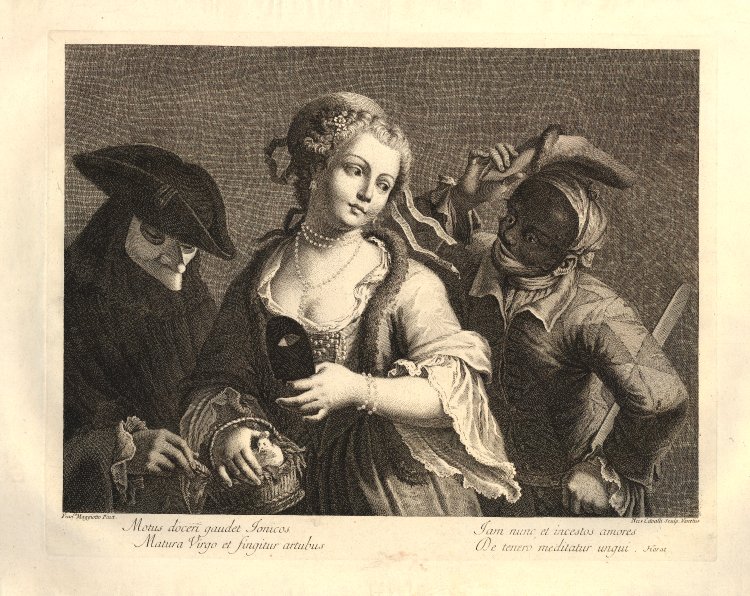
Men in masks

Comparing to my past masquerade posts, this post have few pictures. Partly, I think, because I don't look at pictures of 18th century men as much as I look at those with women. But also, I am sure, because the fashion of getting a painting of yourself in masquerade costumes, never seem to have been very popular. Why I don't know. Perhaps it was felt to be too frivolous. Here is what little I have found:  


Portrait of Count Grigory Chernyshev with a Mask in His Hand by Louise Élisabeth Vigée Le Brun, 1793


Usually men in masks are part of a group containing both men and women.

Print made by Charles Joseph Flipart after Pietro Longhi, 1737-1750

Print by Nicola Cavalli after Francesco Maggiotto

Or in more satirical artwork:


Wantonness Mask'd, 1771

The treacherous patriot unmask'd, ca. 1742


Friday, 12 October 2012

A book on Victorian masquerade costumes


While wandering around on the Net I found this absolutely delightful little book Fancy dresses described; or, what to wear at fancy balls by Ardern Holt from 1896. The book contain useful tips as well as descriptions to several hundred different costumes, some illustrated very charmingly, so if you ever wondered what to wear, here is your answer. I feel a strong urge to attend a Victorian costume ball now!

A few costume examples: Brown-haired ladies can, for example, dress up as a Bees, Bride of Abydos, Esmeralda, Harvest or Rose of Castille. Blondes on the other hand may go as Arctic Maiden, Canadian Snow-wreath, La Belle Dame Sans Merci, Moonlight or a Water-nymph. Elderly ladies can opt to go as My grandmother, Puritan, Wife of the vicar of Wakefield or Mother Hibbard. Men’s costumes isn’t covered in this book, though there are an appendix for boy’s clothes but a married couple can go as Jack and Jill, Cock and Hen, Day and Night or King and Queen.

The book then describes what is proper to wear on the increasingly popular Calico balls, i.e. masquerades where you were cotton. Like Bo-peep, Five O’clock Tea or One of the Rising Generation. However, Calico is a rather elastic word- cotton-backed satin and cotton velvet can be worn.


As it is very uncomfortable to dance without gloves, one has to make allowances for them. Peasant-girls and other simple costumes can make do with mittens. There are also suggestions as hot to wear your hair for various types of costumes. For 18th century costumes it is advised not to wear wigs, as they are heavy and unbecoming. Instead, dress your hair with brilliantine and then powder it with Violet powder. A so called Poudré ball may see the guests in their usual finery, but with powdered hair.

Remember that a costume ball demand more attention on decorations and that also servants and musicians should be in costume. As for dances, country dances are very popular.

The main section describes all the costumes. Here are a few examples, but I think you should go and read the book in whole for all the suggestions.

ASTROLOGY. Short striped satin skirt in amber, black and red. Cabalistic sign on a band of amber, displaying cat’s heads. Bodice and paniers in red satin with the same insignia, all studded with gold and silver stars; short shoulder cape of black satin, black pointed cap with similar signs; powdered hair. Books and telescope carried in the hand.

BAT. Short dress in grey, blue and gold with long sleeves attached to arm from shoulder to wrist, in the semblance of bat wings. A bow on the front of the bodice recalls a bat with outstretched wings. Bat in hair.

DEW. White crystal tulle dress, trimmed with green grass; veil studded with crystal drops. Hair hanging loose, sprinkled with frosting powder; wreath of grasses.

FENCING. A skirt with perpendicular strips of velvet and leather. A leather jacket with a red heart embroidered on the side. A fencing mask forming a headdress; foils hung at the side.

INFLUENZA. Dress of grey tulle with a hot water bottle on one side and a packet of mustard leaves on the other. A pair of scales in the hair attached to a bandeau on which appears the word “quinine”.

OSTRICH. Ostrich all white and black feathers; an arrangement of plumes at the waist counterfeit the train; head-dress, the bird’s head.


The book end with a several pages long advertisement for Debenhams’s & Freebody.

Related Posts Plugin for WordPress, Blogger...